Netanyahu's 19-year rule faces a binary vote in Israel's 120-seat race
Polls show a tight contest between pro and anti prime minister camps, with the outcome potentially hinging on a single parliamentary seat.
By Kavya Robinson ·
Voters in Israel are heading to the polls on Tuesday in a race that centers on one individual rather than a standard left-right divide. Benjamin Netanyahu has served as prime minister for 19 of the last 30 years. The two main camps are defined by their stance on him, and current polling shows them running neck and neck.
The leading opposition candidate is Gadi Eisenkot, a former chief of staff of the Israel Defense Forces. He entered politics only four years ago and represents Yashar, a party whose name means straight or direct. Eisenkot proposes US-style term limits for the prime minister and argues that power corrupts. His supporters value his direct style over political polish.
At a rally in Modi'in this week, attendees praised Eisenkot's plain approach. Noa Sadeh, 56, said she is tired of politicians who focus on speaking and wants a leader who focuses on doing. The opposition bloc also includes former prime ministers Naftali Bennett and Avigdor Lieberman, both of whom are right-wing figures who previously worked with Netanyahu before splitting.
On the far right, the campaign is also focused on Netanyahu. Yishai Fleisher of the Otzma Yehudit party told voters in Bet Shemesh that the prime minister drifts left and needs to be pulled right. He advocated for more settlements in the West Bank and Gaza, a ministry to encourage voluntary Palestinian departure, the death penalty, and increased weapons for Jewish civilians.
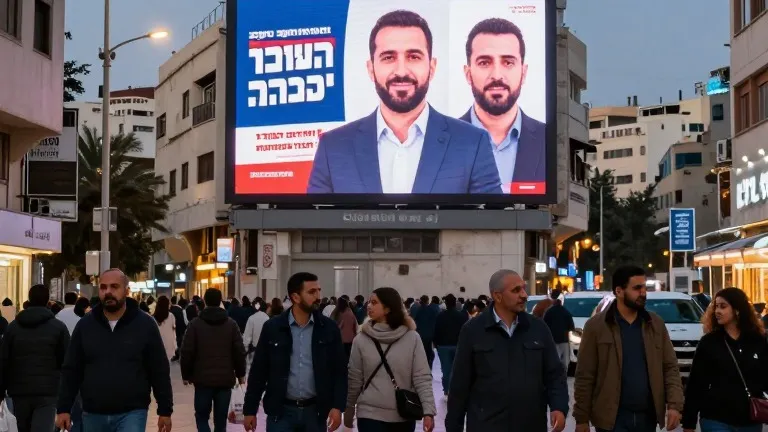
Netanyahu has framed the election as a choice between the right and Palestine. His posters place opposition leaders next to the heads of parties representing Palestinian citizens of Israel, who comprise about a fifth of the population. The central question for the anti-Netanyahu bloc is whether they will rely on mainly Arab parties to form a government, a move that pro-Netanyahu media have used to keep opponents on the defensive.
A recent incident on Channel 14 saw presenter Yinon Magal call Eisenkot a Moroccan monkey. Eisenkot did not use the slur in his speeches, though his speakers did. Admirers viewed his restraint as a strength, while critics suggested he underestimated the intensity of his opponents.
Many observers are puzzled by the tight race given the events of the past three years. The deadliest attack in Israel's history occurred on October 7, 2023, while Netanyahu was in power. The subsequent war in Gaza killed more than 70,000 Palestinians, a figure that includes a third who were Hamas combatants according to Israeli claims. Hamas was not eradicated, and the threat from Iran's nuclear program remains. Netanyahu also faces an ongoing corruption trial and fallout from his attempt to curb the supreme court.
Netanyahu's durability comes from a loyal base built over three decades. His allies claim that military and intelligence chiefs kept him in the dark about the October 7 attack, a claim that lacks support. He is also viewed as a skilled coalition builder who may outmaneuver rivals in post-election talks.
Opposition hopes are partly driven by expatriate Israelis returning home to vote. This group is not always captured in polls but could determine the result if the margin is a single seat in the 120-seat Knesset. On Thursday, a state ceremony marked the 1995 assassination of Yitzhak Rabin. Netanyahu sent a low-ranking minister to the event while he stayed away.
Yair Golan, leader of the Democrats party, said he is optimistic about the opposition forming a strategic process for long-term security. He avoided using the term peace process, a phrase that has become controversial. A video from a Negev music festival showed young Israelis singing a song associated with Rabin, signaling that some view the current political era as nearing its end.
Source: The Guardian