Michigan Income Rises Yet Stays Below National Median
The state lost fewer than 12,600 residents in 2025, while Detroit and Grand Rapids saw modest growth and household incomes rose.
By Arjun Wojcik ·
Resident life in Michigan showed little change in 2025. The US Census Bureau reported that the state’s population remained near 10.1 million. This figure represents a small decline of 12,575 people compared to 2024. The drop amounted to less than half a percent. It follows two years of estimated population growth for the state.
Specific cities experienced slight upward movement. Detroit, the state’s largest city, added 3,413 residents. Its population reached an estimated 649,115. Grand Rapids followed with an increase of 1,049 people, bringing its total to 201,180. Lansing saw the largest percentage gain among major cities. It added 1,317 new residents, a 1.2 percent rise. That growth placed Lansing at 114,783, making it the sixth largest city in the state.
Other major urban areas saw small decreases. Dearborn, Southfield, Rochester Hills, and Farmington Hills each lost approximately 800 residents. The data comes from the American Community Survey. This annual study covers areas with populations exceeding 65,000. It tracks variables including education, income, and transportation habits.
Household finances improved slightly in the state. The median household income rose from $72,389 in 2024 to $75,832 in 2025. Despite this gain, Michigan remains below the national median of $84,780. Educational attainment also showed mixed results. Ninety-two point seven percent of Michigan adults hold a high school diploma or equivalent. This exceeds the national estimate of 90.6 percent. However, only 33.9 percent of the state’s population holds a bachelor’s degree or higher. The national average stands at 37.4 percent.
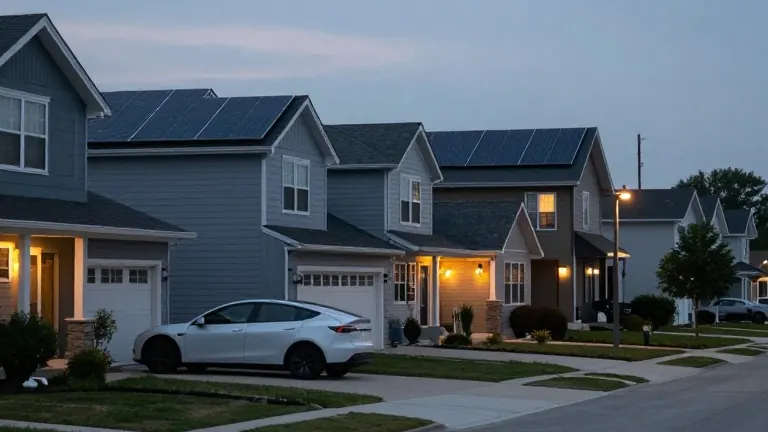
The survey introduced new metrics for electric vehicles and solar panels. An estimated 148,819 Michigan households owned an electric vehicle in 2025. This represents about 4 percent of households. The national average was 5.5 percent. Tricia Holley, a survey statistician at the Census Bureau, noted that western states lead in adoption. She stated that California had the highest rate, followed by Washington, Hawaii, and Nevada.
Solar panel ownership also lagged behind neighboring states. The Census estimated that 65,918 Michigan households had solar panels. Illinois reported 177,113 households with the technology, while Ohio reported 72,125. These figures place Michigan behind both of those states in adoption rates. The data provides a snapshot of current living standards and infrastructure usage in the region.
Source: Bridge Michigan