Netanyahu Bloc Projected at 53 Seats as Israel Faces Coalition Deadlock
With almost five million votes counted, the Central Elections Committee projects 53 seats for the prime minister's bloc, 48 for the opposition and 19 for Arab parties.
By Arjun Wojcik ·
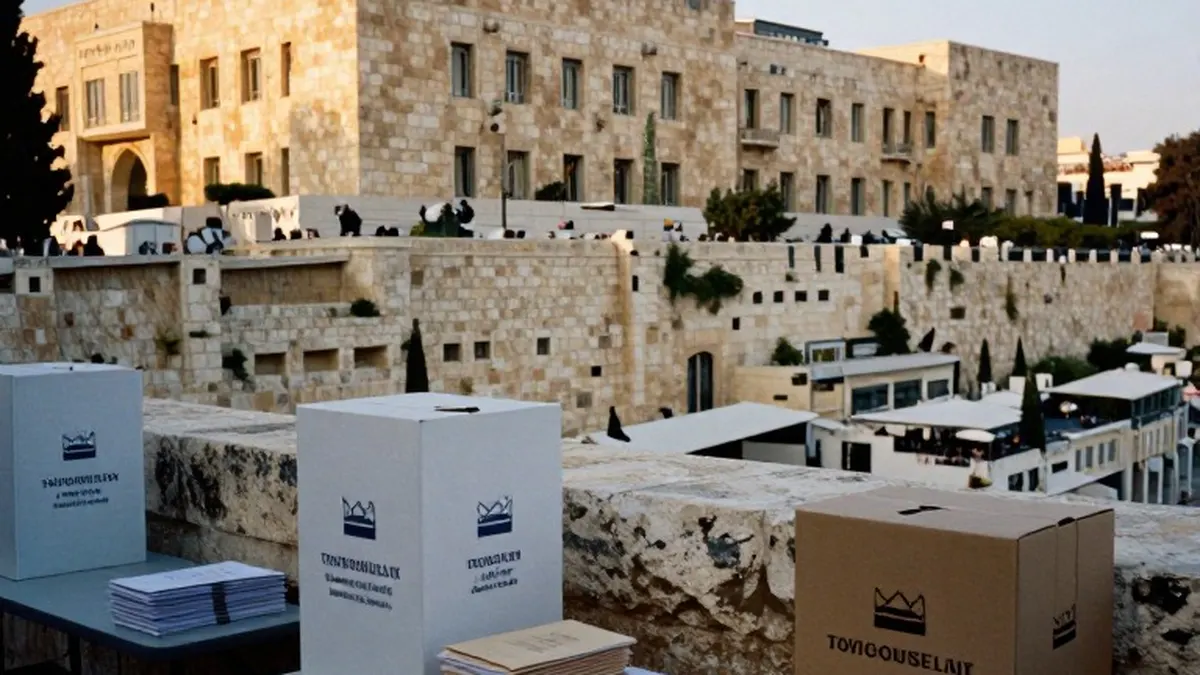
Prime Minister Benjamin Netanyahu's bloc is expected to enter the next Knesset with 53 seats, according to figures released on Wednesday by Israel's Central Elections Committee after almost five million votes had been counted.
Within that bloc, Netanyahu's Likud is projected to win 26 seats. United Torah Judaism, Shas and Otzma Yehudit are each expected to take seven, while the Religious Zionist Party is projected to secure six.
The opposition bloc is projected at 48 seats. It is made up of Gadi Eisenkot's Yashar with 21 seats, B'Yachad, led by Naftali Bennett and Yair Lapid, with 12, Yair Golan's Democrats with eight, and Avigdor Liberman's Yisrael Beytenu with seven.
The committee's latest data also gives 19 seats to Arab parties, with the Joint List projected at 12 and Ra'am at seven.
Neither side appears to have a clear path to the 61 seats needed for a majority. A unity government between Netanyahu and Eisenkot looks unlikely, since Eisenkot has refused to serve under Netanyahu, including in a rotation arrangement. Other opposition leaders have likewise ruled out joining a coalition led by the prime minister.
Eisenkot has urged that the leader of the largest party in the opposition bloc become its candidate for prime minister, though the bloc has announced no agreement on the matter. Exit polls had also raised the possibility of a minority government that could pass a Knesset confidence vote without 61 seats. Resistance inside the opposition bloc to relying on Arab parties could complicate that option. The deadlock could ultimately lead to another election, although coalition talks may still produce a deal.
Golan argued that Netanyahu's camp had lost. Counting the Arab parties, he said, the opposition bloc reaches 65 seats. "Netanyahu lost. I know how to count to 120. Sixty-five is more than 55. That's how Israeli democracy works. Period," he wrote on Wednesday morning. He added that if Netanyahu were considering a Zionist bloc, he should subtract the 16 members of the non-Zionist Haredi parties from his own camp.
Golan said the opposition has a majority, a responsibility and an opportunity to form a government of change in partnership with Israel's Arab citizens, one that would serve all Israelis.
Joint List chairman Yousef Jabareen said his party was ready to "pave the way for the ousting of the Netanyahu government." In a post on X, he described the alternative as one built on Jewish-Arab partnership, "a true and equal partnership."
Later, in an interview with Army Radio, Joint List faction chairman Ahmad Tibi of Hadash-Ta'al signaled openness to working with the opposition. "The opposition bloc will be able to form a government if it has the courage. We are extending a hand and are ready to help," he said.
Source: The Jerusalem Post