Breaking: Election Day is here! Make your selections: The world watches as Americans decide Congress, governors and the path forward
Voters across the United States are casting ballots in the 2026 midterms, a critical contest that will determine the balance of power in Congress and the statehouses for the next two years of President Trump's term.
By Arjun Wojcik ·
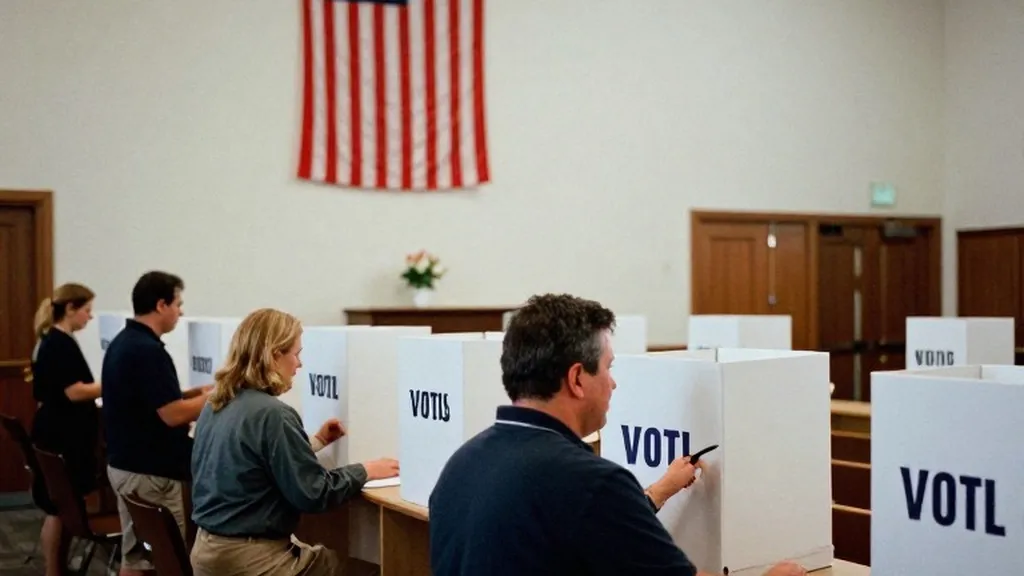
It is Election Day in the United States, a moment that captures the attention of citizens and observers around the globe. For readers outside America, this is a midterm election, which takes place halfway through a president's four year term. The outcome does not change who sits in the Oval Office, but it decides which political party controls the legislative branch and how many state leaders the party holds. This balance of power shapes the ability of the White House to pass laws, fund the military, negotiate trade deals, and respond to international crises. As polls open across the country, the world is watching to see if the governing party will maintain its grip or if the opposition will seize control of the levers of government.
The stakes in Washington are particularly high this year. All 435 seats in the U.S. House of Representatives are up for election, according to Ballotpedia. Republicans currently hold 218 of these seats, while Democrats hold 214, with one independent and some vacancies. For Democrats to take control of the House, they need to win a net gain of three districts. Republicans, on the other hand, can afford to lose no more than two seats to keep their majority. In the Senate, 35 seats are on the ballot, including 33 regular elections and two special elections. Republicans hold 53 seats and Democrats 45, with two independents who usually vote with the Democrats. Democrats need to win four more seats than the Republicans to gain control of the Senate, a difficult but not impossible task. The winners of these Senate races will begin their six year terms on January 3, 2027.
Beyond the federal legislature, voters in 36 states are choosing their governors. These state leaders have significant influence over domestic policy, including education, infrastructure, and healthcare. Republicans currently hold 26 governorships and Democrats 24, but 36 of those offices are up for grabs. According to Ballotpedia, Democrats would need to win a net gain of two governorships to claim a nationwide majority, a position Republicans have held since 2010. The control of these statehouses matters to the world because governors often play a key role in implementing federal policies and managing state level responses to economic shifts and public health challenges.
For international observers, the outcome of these races has direct implications for global markets and diplomatic relations. Reuters notes that Wall Street is closely watching the results, as they could impact investor confidence regarding artificial intelligence spending and debt ceiling negotiations. A change in control of Congress could lead to new legislation or investigations that affect the U.S. economy, which is the largest in the world. Furthermore, the U.S. is currently engaged in a war with Iran, and the mood among American voters is described by the Associated Press as one where people are angry over an unpopular conflict and struggling with high prices. If the opposition party gains power, it may signal a shift in foreign policy priorities, potentially affecting alliances and trade agreements.
The Associated Press describes this election as a referendum on President Donald Trump's second term. Recent polling from AP NORC shows that 35 percent of U.S. adults approve of his job performance, while only 25 percent approve of his handling of the economy. About seven in 10 Americans say the country is heading in the wrong direction, and most blame the president for rising costs. Despite this, Trump has been active in campaigning, holding dozens of rallies, including one in Salina, Kansas, where he told supporters to pretend he was on the ballot. His presence has energized some Republican candidates, though many have kept their distance to avoid being seen as too closely aligned with the president during a challenging period.
The financial aspects of this election are historic. According to the Associated Press, the 2026 elections are likely to be the most expensive in history. Republican committees have outraised and outspent their Democratic counterparts, helped by groups affiliated with President Trump and billionaire Elon Musk. At the candidate level, however, Democrats have outraised their opponents. This spending has been heavily concentrated in states and districts that Trump won in 2024, with 88.1 percent of Republican general election television ad spending going to those areas. This strategy suggests that Republicans are trying to protect their base while Democrats focus on competitive districts where small margins could decide the outcome.
Voters have already shown high levels of engagement. More than 57 million people had voted by Monday, surpassing early vote totals from four years ago in many closely watched states. This early turnout indicates a high level of interest and potential volatility in the final results. As polls open today, the race remains tight in several key states. In the Senate, races in Maine, Iowa, Kansas, Alaska, Michigan, and Georgia are considered battlegrounds. In Maine, for example, the race between Senator Susan Collins and Democratic candidate Troy Jackson is a toss up, according to multiple ratings. The Associated Press notes that economic strain and tariffs have made the state competitive, highlighting how domestic economic issues are influencing the political landscape.
The governor races are also fiercely contested. In Georgia, Republican health care executive Rick Jackson faces Democratic former Atlanta Mayor Keisha Lance Bottoms. In Nevada, Republican Governor Joe Lombardo is running against Democratic Attorney General Aaron Ford. In Ohio, Republican Vivek Ramaswamy is competing against Democrat Amy Acton. These races are significant because they could shift the balance of power at the state level. Democrats hope to hold a majority of governorships for the first time in two decades, which would give them more influence over state policies that affect the broader national economy and social fabric.
How to vote today is a question many first time or out of country voters ask. You can find your polling place at vote.gov or your state election office. It is important to check the specific hours for your state, as they vary. For example, in Florida, polls are open from 7 a.m. to 7 p.m. Eastern and Central time. In New York, they are open from 6 a.m. to 9 p.m. In California, which largely votes by mail, polls are open from 7 a.m. to 8 p.m. If you are in line when polls close, you are entitled to vote, so it is worth staying in line if you arrive near the end of the voting window. ID rules vary by state, so check your state's requirements before heading to the polls.
The administration of this election has been a topic of legal debate. A federal judge temporarily barred the Trump administration from carrying out a plan it says would prevent noncitizen voting, according to Reuters. Another judge ordered the administration to stop demanding that California election officials segregate ballots cast by people on lists of suspected noncitizens. These legal moves have raised concerns among critics who fear they could disenfranchise eligible voters. The U.S. Postal Service has added hours, staff, and special lines to ensure that mail ballots are counted on time, a crucial step given the high volume of mail voting in several states.