Kyiv’s subway stations become dormitories as Russian strikes intensify
With 140 deaths recorded in the first eight months of 2026, the capital faces its deadliest period since the 2022 invasion began.
By Liam Kaminski ·
The quiet rhythm of daily life in Kyiv has fractured. For months, the capital offered a relative calm compared to the front lines, but that buffer has vanished. As Russia widens its bombardment, the city of four million residents now functions less like a rear hub and more like a forward combat zone.
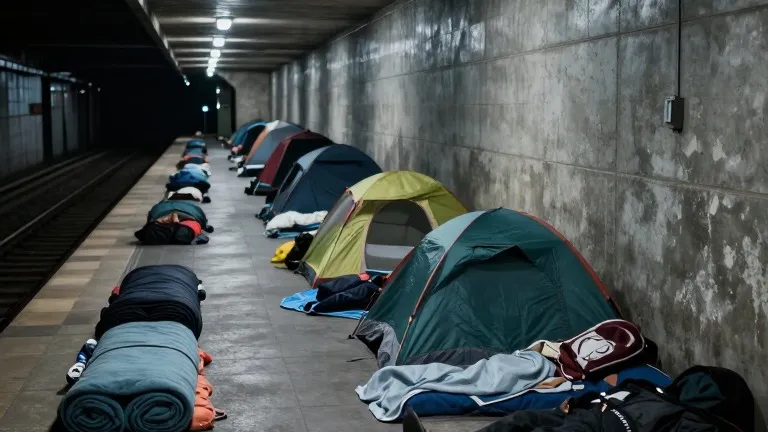
The scarcity of adequate shelters has forced a structural shift in how citizens survive the night. Subway stations have converted into improvised dormitories. By 10 p.m., residents lay out mattresses and erect small tents on the platforms. Children sleep beside adults, while pets find space among strangers against the cold walls.
Halyna, a resident of the Lukyanivka district, holds her five-year-old son Roman in the station. The district has been a repeated target throughout the four years and eight months of the war. "We're alive," she says. "We've been lucky once again." On most evenings, she takes Roman to the nearest station, even when no siren sounds.
The strikes have claimed young lives in central districts. In September, a Russian drone hit an apartment building in Pechersk, killing 14-year-old Daniel Umanskyj while he did homework. Vlad, a neighbor, was in the hallway with his daughter at the time. "We were late that day, and this saved our lives," Vlad said. "These sick monsters don't care who they kill." Flowers now mark the building in Daniel's memory.
Educational institutions have also come under fire. In early October, a drone struck a school in southwestern Kyiv. Principal Valentyna Chorna stated that pupils and teachers were already in shelter. The school maintains in-person classes for grades one through nine because its facility holds more than 500 students.
Attendance now hinges on shelter capacity and the duration of sirens. If an alarm sounds in the morning, children may miss school. A reporter at a local news bureau noted the strain on parents who must work while children stay home. The walk to school carries risk, as alerts can start at any moment. Her own building was struck in September, though her daughter was at school and the apartment sustained no damage.
Military administration data shows 140 people were killed in Kyiv during the first eight months of 2026. This exceeds the 172 deaths recorded for all of 2025. If the current pace holds, 2026 will be the deadliest year for the capital since the full-scale invasion began in 2022.
Logistical challenges compound the human toll. Strikes on warehouses have triggered supermarket shortages not seen since the war's early months. Emergency power outages returned in late September, and a recent attack paralyzed the subway system. With energy infrastructure under fire, the city faces uncertainty regarding heat, electricity, and water reliability for the winter.
Despite the pressure, residents report high resilience. A report from the Kyiv International Institute of Sociology indicated that 72% of residents said in September they were ready to endure the war as long as necessary.
Authorities are adjusting routines to preserve normalcy. The curfew now runs from 1 a.m. to 5 a.m. Some facilities may operate during "yellow" alerts. During "red" alerts, which signal ballistic or cruise missiles or large combined attacks, residents must take shelter immediately.
Source: Deutsche Welle